A child’s eyes may look normal, but one eye may not be developing normal vision. This condition is known as amblyopia, commonly called lazy eye.
Amblyopia is a condition in which vision in one eye—or sometimes both eyes—does not develop normally during childhood. It is one of the most common causes of reduced vision in children.
The good news is that early diagnosis and appropriate treatment can significantly improve vision in many children. However, delaying treatment can make the condition more difficult to correct.
At Bloom Vision Eye Clinic, Dr. Abhishek Sharma, MBBS, MS (Ophthalmology), provides pediatric eye evaluation and management of conditions including amblyopia and squint.
What Is Lazy Eye (Amblyopia)?
Amblyopia is reduced vision in an eye that has not developed normal visual function during early childhood.
It is not simply a problem with the eye itself. The condition develops because the brain and the affected eye do not work together normally during the critical period of visual development.
The brain may gradually rely more heavily on the stronger eye and pay less attention to the weaker eye.
As a result, the weaker eye does not develop normal visual processing.
Amblyopia can affect:
- One eye
- Both eyes
- Distance vision
- Near vision
- Depth perception
What Causes Lazy Eye?
Amblyopia can develop for several reasons.
The most common causes include:
1. Refractive Amblyopia
A significant difference in the refractive error between the two eyes can cause one eye to receive a consistently blurrier image.
This is known as anisometropia.
Amblyopia can also develop when both eyes have a high degree of refractive error.
2. Strabismic Amblyopia
Strabismus, commonly known as squint or crossed eyes, occurs when the eyes are not properly aligned.
When the brain receives conflicting images from misaligned eyes, it may suppress the image from one eye to avoid double vision.
Over time, this can result in amblyopia.
3. Amblyopia Due to Visual Obstruction
Anything that prevents a clear image from reaching the retina during early childhood can interfere with normal visual development.
Examples include:
- Childhood cataract
- Droopy eyelid (ptosis)
- Corneal opacity
- Other conditions that block vision
This type can be particularly serious because treatment of the underlying problem may be needed as early as possible.
4. Mixed Amblyopia
Some children have more than one contributing factor—for example, significant refractive error combined with eye misalignment.
What Are the Symptoms of Lazy Eye?
One of the challenges with amblyopia is that children may not realize that their vision is abnormal.
They may adapt to using their stronger eye and continue their normal activities.
Possible signs include:
- One eye turning in or out
- Frequently closing one eye
- Tilting or turning the head
- Difficulty judging distances
- Poor hand-eye coordination
- Difficulty reading
- Sitting very close to screens
- Squinting
- Complaints of blurred vision
- Difficulty seeing objects clearly
- Poor performance in activities requiring visual coordination
However, some children have no obvious symptoms.
This is why routine childhood vision screening and eye examinations are important.
Can Parents Detect Lazy Eye at Home?
Parents may notice some warning signs, but a home observation cannot reliably diagnose amblyopia.
Watch for:
- One eye drifting
- Frequent eye rubbing
- Closing one eye when looking at something
- Head tilting
- Difficulty recognizing objects from a distance
- Problems with reading or schoolwork
- Difficulty catching a ball
- Unusual visual behavior
If you notice these signs, an eye examination is recommended.
At What Age Does Amblyopia Develop?
Amblyopia develops during childhood while the visual system is still developing.
The earlier the problem begins and remains untreated, the greater the risk of reduced visual development.
This is why identifying and treating amblyopia during early childhood is important.
The American Academy of Ophthalmology emphasizes early detection of childhood vision problems because untreated amblyopia can result in permanent visual impairment.
Can Adults Develop Lazy Eye?
Amblyopia generally develops during childhood rather than suddenly appearing in adulthood.
An adult who experiences new reduced vision in one eye should not assume it is lazy eye.
Sudden or newly developing vision loss can have many other causes and should be evaluated promptly by an ophthalmologist.
Adults who had untreated amblyopia during childhood may continue to have reduced vision in the affected eye.
How Is Lazy Eye Diagnosed?
Amblyopia is diagnosed through a comprehensive eye examination.
Depending on the child’s age and cooperation, the ophthalmologist may assess:
Visual Acuity
The doctor measures how clearly each eye can see.
The difference in vision between the two eyes can provide important information.
Refraction
A refraction test determines whether the child has:
- Myopia
- Hyperopia
- Astigmatism
- A significant difference between the two eyes
Eye Alignment
The ophthalmologist checks whether the eyes are properly aligned and working together.
Eye Movement
Eye movements are assessed to identify abnormalities that may contribute to reduced vision.
Examination of the Eye
The doctor examines the structures of the eye to rule out conditions such as cataract or other abnormalities that could interfere with vision.
Can Lazy Eye Be Treated?
Yes.
Treatment depends on the cause and severity of amblyopia, the child’s age, and the vision of each eye.
Common treatment approaches include:
- Corrective glasses
- Eye patching
- Atropine eye drops in selected cases
- Treatment of underlying eye conditions
- Management of associated strabismus
- Additional vision-based treatments when appropriate
The earlier treatment begins, the better the opportunity to improve visual development.
1. Prescription Glasses
Corrective glasses are often the first step when refractive error contributes to amblyopia.
Glasses can provide a clearer image to the affected eye and may be sufficient to improve vision in some children.
Your ophthalmologist will determine the appropriate prescription.
2. Eye Patching
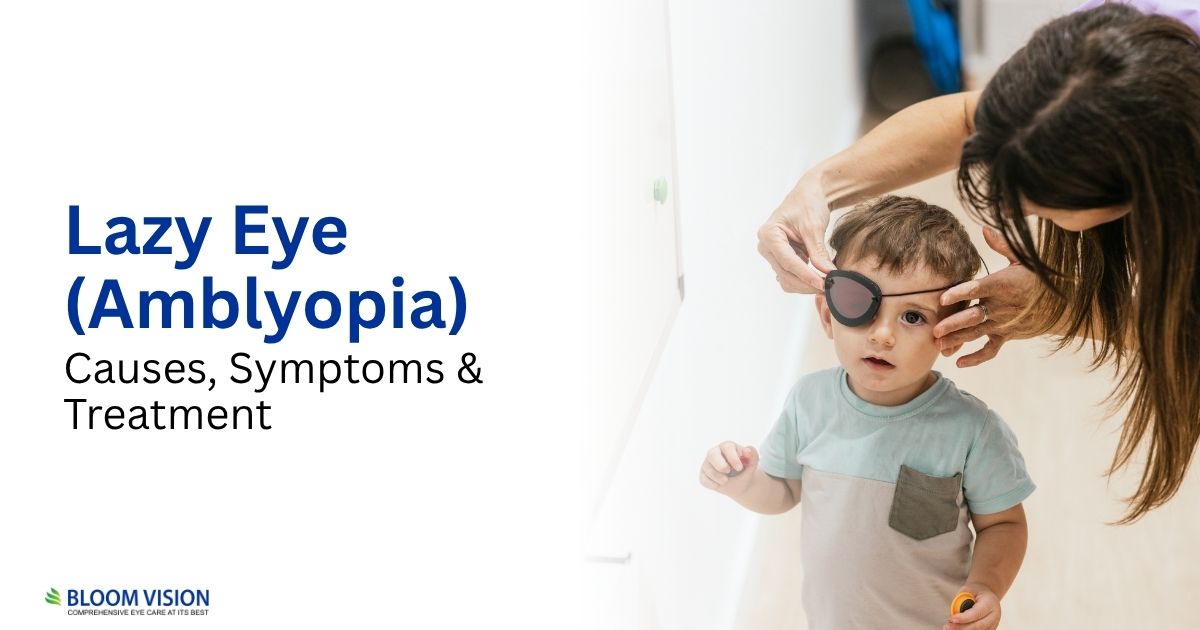
Patching the stronger eye is one of the commonly used treatments for amblyopia.
The patch temporarily covers the stronger eye, encouraging the brain to use the weaker eye.
The amount of patching depends on the severity of amblyopia and the child’s individual treatment plan.
Parents should follow the ophthalmologist’s recommended patching schedule rather than changing the duration themselves.
3. Atropine Eye Drops
In selected children, an ophthalmologist may prescribe atropine eye drops in the stronger eye.
Atropine temporarily blurs near vision in that eye, encouraging the child to use the weaker eye.
It can be an alternative to patching for some children.
4. Treating the Underlying Cause
If amblyopia is caused by something obstructing vision—such as a cataract or significant droopy eyelid—the underlying condition may need to be treated.
In these cases, treatment should not be delayed because clear visual input is important during childhood visual development.
5. Treatment of Squint
If amblyopia is associated with strabismus, the child may need treatment for both conditions.
Depending on the type and severity of the squint, treatment may include glasses, patching, eye exercises in selected situations, or surgery when clinically indicated.
How Long Does Lazy Eye Treatment Take?
There is no single treatment duration for every child.
Treatment may continue for several months or longer depending on:
- The child’s age
- Severity of amblyopia
- Cause
- Difference in vision between the eyes
- Response to treatment
- Consistency with glasses or patching
- Presence of associated eye conditions
Regular follow-up appointments allow the ophthalmologist to measure progress and modify treatment when necessary.
Is Lazy Eye Permanent?
Amblyopia can sometimes cause permanent reduction in vision if it is not treated during the period when the visual system is developing.
However, many children can achieve significant improvement with timely and appropriate treatment.
The outcome depends on several factors, including the age at which treatment begins, the severity of amblyopia and how consistently treatment is followed.
What Happens If Lazy Eye Is Not Treated?
Untreated amblyopia can lead to:
- Permanently reduced vision in the affected eye
- Poor depth perception
- Difficulty with activities requiring both eyes
- Greater dependence on the stronger eye
In some cases, the weaker eye may remain significantly impaired into adulthood.
This is why parents should not wait for a child to “outgrow” suspected vision problems without an appropriate eye examination.
Can Eye Exercises Cure Lazy Eye?
Eye exercises are sometimes promoted as a treatment for amblyopia, but they should not replace evidence-based treatment prescribed by an ophthalmologist.
The appropriate treatment depends on the cause of amblyopia.
For children with refractive amblyopia, for example, correcting the refractive error and, when necessary, using patching or atropine may be recommended.
Any additional vision therapy should be discussed with a qualified eye specialist.
Can Lazy Eye Be Prevented?
Not every case of amblyopia can be prevented.
However, early detection of childhood vision problems can reduce the risk of long-term visual impairment.
Parents can help by:
- Following recommended childhood eye screening
- Getting an eye examination if they notice unusual visual behavior
- Ensuring children wear prescribed glasses
- Following patching instructions carefully
- Attending follow-up appointments
- Informing the ophthalmologist about family history of squint or childhood eye problems
When Should a Child See an Eye Specialist?
Parents should arrange an eye examination if their child:
- Has an eye that turns in or out
- Frequently closes one eye
- Tilts the head while looking
- Complains of blurred or double vision
- Has difficulty reading
- Struggles to see the board at school
- Frequently bumps into objects
- Has difficulty with hand-eye coordination
- Has a family history of amblyopia or strabismus
- Has an unusual appearance of the eye
Children with a known eye condition should follow the examination schedule recommended by their ophthalmologist.
Lazy Eye vs Squint: Are They the Same?
No.
Lazy eye (amblyopia) means reduced visual development in one or both eyes.
Squint (strabismus) means the eyes are not properly aligned.
The two conditions are different, but they can occur together.
A child with a squint may develop amblyopia because the brain suppresses the image from the misaligned eye.
Therefore, both eye alignment and visual acuity should be assessed.
Frequently Asked Questions About Lazy Eye
Is lazy eye the same as poor eyesight?
No. Amblyopia is reduced visual development caused by abnormal visual input during childhood. Ordinary refractive errors such as myopia or astigmatism can usually be corrected with glasses or contact lenses.
Does every child with a squint develop lazy eye?
No. However, strabismus can increase the risk of amblyopia, so children with a squint should be evaluated by an eye specialist.
Can glasses treat lazy eye?
Glasses can be an important part of treatment when refractive error contributes to amblyopia. Some children may need additional treatment such as patching or atropine.
Does patching improve lazy eye?
Patching the stronger eye can encourage the brain to use the weaker eye and is a commonly used treatment for amblyopia.
Can lazy eye come back after treatment?
Vision can sometimes decrease again after successful treatment, particularly if treatment is stopped too soon. Continued follow-up is important to monitor visual development.
Can amblyopia affect both eyes?
Yes. Although amblyopia is commonly associated with one weaker eye, it can affect both eyes when both eyes have significant uncorrected refractive errors.
Why Choose Bloom Vision Eye Clinic for Amblyopia Management?
At Bloom Vision Eye Clinic, children can receive comprehensive pediatric eye examinations to identify vision problems at an early stage.
Under the care of Dr. Abhishek Sharma, MBBS, MS (Ophthalmology), pediatric eye care includes evaluation and management of conditions such as:
- Amblyopia (lazy eye)
- Squint/strabismus
- Refractive errors
- Childhood vision problems
- Pediatric eye conditions
- Vision development concerns
The treatment plan is tailored to the child’s age, visual acuity, eye alignment, refractive error and underlying cause.
Final Thoughts
Lazy eye (amblyopia) is a childhood vision-development condition that should not be ignored.
Because children may not realize that one eye is weaker than the other, amblyopia can sometimes remain unnoticed by parents.
Early eye examinations can help identify problems such as refractive errors, squint or other conditions that interfere with normal visual development.
If your child shows signs of reduced vision, eye misalignment or unusual visual behavior, consult a pediatric ophthalmologist for a comprehensive evaluation.
Book a Pediatric Eye Consultation at Bloom Vision Eye Clinic
Bloom Vision Eye Clinic – Dwarka
Plot No. 65, Sector-12A Road, Block A, Sector 12, Dwarka, Delhi – 110078
Phone: +91 76785 31120
Bloom Vision Eye Clinic – Gurugram
2609-A, Opposite DSOI, Block F, Sector 2, Palam Vihar, Gurugram, Haryana – 122017
Phone: +91 99717 16288
Consult Dr. Abhishek Sharma for comprehensive pediatric eye evaluation and amblyopia management.