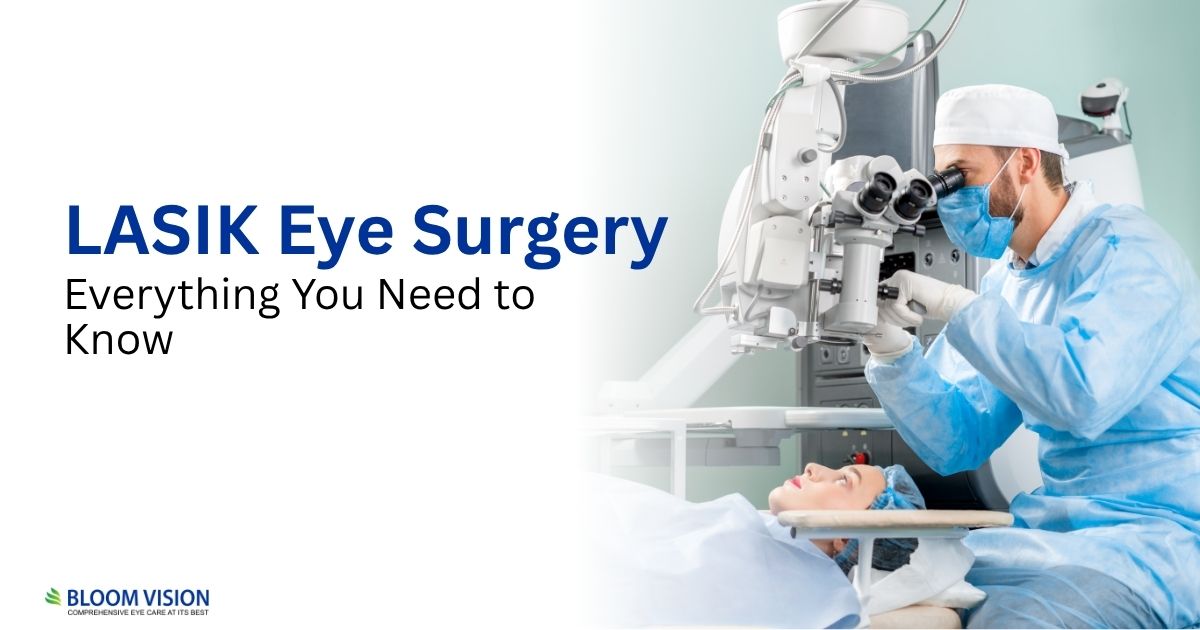
Glasses and contact lenses are effective ways to correct vision, but some people look for a longer-term alternative that can reduce their dependence on them. LASIK eye surgery is one of the most widely known laser vision correction procedures used for this purpose.
LASIK, or Laser-Assisted In Situ Keratomileusis, reshapes the cornea to change how light is focused onto the retina. The procedure is designed to correct certain refractive errors and reduce dependence on glasses or contact lenses.
However, LASIK is not suitable for everyone. A detailed eye examination is essential before deciding whether LASIK, FEMTOLASIK, SMILE, another refractive procedure, or glasses and contact lenses are appropriate.
At Bloom Vision Eye Clinic, Dr. Abhishek Sharma, MBBS, MS (Ophthalmology), provides comprehensive evaluation and refractive eye-care options for eligible patients.
What Is LASIK Eye Surgery?
LASIK is a laser vision correction procedure that permanently reshapes the cornea.
The cornea is the clear front surface of the eye. When the shape of the cornea causes light to focus incorrectly on the retina, it can result in refractive errors such as:
- Myopia or short-sightedness
- Hyperopia or long-sightedness
- Astigmatism
During LASIK, a thin corneal flap is created, the underlying corneal tissue is reshaped using an excimer laser, and the flap is repositioned.
The goal is to improve unaided vision and reduce dependence on glasses or contact lenses.
How Does LASIK Work?
LASIK changes the focusing power of the eye by reshaping the cornea.
In simplified terms, the procedure involves:
- Pre-operative evaluation
- Numbing the eye with anesthetic drops
- Creating a thin corneal flap
- Reshaping the cornea with a laser
- Repositioning the corneal flap
- Post-operative examination and follow-up
The exact technique and technology used depend on the patient’s eye measurements, corneal characteristics, prescription and the surgeon’s treatment plan.
Who Can Be a Candidate for LASIK?
Not everyone who wears glasses or contact lenses is automatically a LASIK candidate.
A detailed evaluation generally considers:
- Age
- Stability of spectacle or contact-lens prescription
- Corneal thickness
- Corneal shape
- Overall eye health
- Tear-film and dry-eye status
- Pupil size
- Degree and type of refractive error
- Previous eye surgery or injury
- General medical conditions
- Medications
- Individual expectations
A comprehensive pre-operative assessment is particularly important because conditions affecting the cornea or ocular surface can influence both suitability and the accuracy of surgical planning.
Is There an Age Limit for LASIK?
LASIK is generally performed on adults. In the United States, FDA-approved LASIK systems are not approved for people under 18.
However, age alone does not determine suitability.
The eye should be appropriately developed and the refractive prescription should be sufficiently stable. Your ophthalmologist will assess your individual circumstances before recommending surgery.
Who May Not Be Suitable for LASIK?
LASIK may not be recommended in certain situations.
Examples include:
Unstable Eye Prescription
If your glasses or contact-lens prescription has changed significantly recently, your refractive error may not yet be stable enough for surgery.
Thin or Abnormally Shaped Cornea
Corneal thickness and shape are important considerations because LASIK involves removing a controlled amount of corneal tissue. Certain corneal conditions may make laser vision correction inappropriate.
Significant Dry Eye
LASIK can worsen pre-existing dry eye, and some patients may develop dry-eye symptoms after surgery.
Certain Medical Conditions
Some diseases or medications can affect healing and may increase the risks associated with refractive surgery.
Certain Eye Conditions
Conditions such as keratoconus, some forms of glaucoma, previous eye injuries or surgeries and other ocular problems require careful assessment before considering LASIK.
Pregnancy and Breastfeeding
Hormonal changes during pregnancy and breastfeeding can affect vision and refractive stability. LASIK is generally postponed during these periods and until the eyes and prescription have stabilized.
What Tests Are Done Before LASIK?
The pre-operative assessment is one of the most important parts of LASIK treatment.
Your ophthalmologist may evaluate:
- Visual acuity
- Refraction
- Corneal thickness
- Corneal curvature and shape
- Tear production and ocular surface
- Pupil size
- Eye pressure
- Retina and optic nerve
- Overall eye health
Corneal mapping and other diagnostic measurements can help the surgeon understand the structure of the cornea and determine whether laser vision correction is appropriate.
A detailed evaluation also helps identify patients who may have an increased risk of complications.
What Happens During LASIK Surgery?
LASIK is performed using local anesthetic eye drops, so the eye is numbed during the procedure.
The surgeon first prepares the eye and creates a thin flap in the cornea. The laser is then used to reshape the underlying corneal tissue according to the patient’s treatment plan.
The flap is subsequently repositioned.
LASIK does not usually involve stitches to hold the flap in place. A protective eye shield may be used after surgery, particularly while sleeping, to help prevent accidental rubbing or pressure on the eye.
Your surgeon will provide specific instructions based on your procedure and recovery.
Does LASIK Hurt?
Because numbing eye drops are used, patients generally do not experience significant pain during the procedure.
After surgery, some people may experience:
- Burning or irritation
- Watery eyes
- Light sensitivity
- A sensation of something being in the eye
- Temporary blurred or hazy vision
- Mild discomfort
These symptoms generally improve during the early recovery period, but individual experiences vary.
How Long Does LASIK Recovery Take?
Recovery varies from person to person.
Vision can be blurry or hazy immediately after the procedure. Some visual symptoms may improve substantially during the first few days, while vision can continue to fluctuate as the eyes heal.
The FDA notes that vision may take three to six months to stabilize following LASIK in some patients.
Your ophthalmologist will provide instructions regarding:
- Eye drops
- Eye protection
- Screen use
- Driving
- Exercise
- Swimming
- Makeup
- Contact sports
- Follow-up appointments
Do not rub your eyes during the recovery period.
What Are the Benefits of LASIK?
For appropriately selected patients, LASIK may offer several potential benefits:
- Reduced dependence on glasses
- Reduced dependence on contact lenses
- Improved unaided distance vision
- Quick visual rehabilitation in many patients
- No need for daily contact-lens insertion and removal
- Potential convenience for sports and active lifestyles
However, LASIK does not guarantee perfect vision or eliminate the future need for glasses.
The FDA specifically notes that some patients may still require glasses or contact lenses after surgery, including reading glasses.
What Are the Risks of LASIK?
Like any surgical procedure, LASIK has potential risks and limitations.
Possible complications and side effects include:
- Dry eyes
- Glare
- Halos around lights
- Starbursts
- Difficulty with night vision
- Fluctuating vision
- Undercorrection
- Overcorrection
- Residual refractive error
- Infection or inflammation
- Problems involving the corneal flap
- Need for additional treatment
- In uncommon cases, loss of some vision
The FDA also notes that some patients can experience visual symptoms even when standard vision-chart results appear good.
This is why a detailed pre-operative examination and realistic expectations are essential.
Can LASIK Guarantee 20/20 Vision?
No eye surgery can guarantee a particular visual result for every patient.
Many patients experience substantial improvement in unaided vision, but outcomes depend on factors such as the original prescription, corneal characteristics, ocular health, surgical planning and individual healing.
Some people may still need glasses for particular activities, such as night driving or reading.
The FDA advises patients to understand that not everyone achieves 20/20 vision without glasses or contact lenses.
LASIK and Reading Glasses
One important point to understand is that LASIK does not stop the natural aging process of the eye.
Presbyopia, the age-related reduction in the eye’s ability to focus on near objects, generally develops with age.
Therefore, a person who has undergone successful distance vision correction may eventually need reading glasses.
This is particularly important for patients considering LASIK around or after the age when presbyopia becomes clinically significant.
LASIK vs FEMTOLASIK vs SMILE
LASIK is not the only option for laser vision correction.
Depending on the patient’s eye structure and prescription, an ophthalmologist may discuss procedures such as:
LASIK
LASIK involves creating a corneal flap and using an excimer laser to reshape the cornea.
FEMTOLASIK
FEMTOLASIK uses a femtosecond laser to create the corneal flap rather than a mechanical blade. The cornea is then reshaped using an excimer laser.
SMILE
SMILE, or Small Incision Lenticule Extraction, uses a femtosecond laser to create and remove a small piece of corneal tissue through a small incision.
The most appropriate procedure depends on individual eye measurements and clinical suitability. There is no single refractive procedure that is appropriate for every patient.
What Should You Do Before LASIK?
Your eye specialist may provide specific instructions before surgery.
Depending on your circumstances, these may include:
- Completing a comprehensive eye examination
- Temporarily discontinuing contact lenses before measurements
- Informing your doctor about medications and medical conditions
- Avoiding eye makeup before surgery
- Arranging transportation home
- Understanding post-operative care
- Discussing your expectations and concerns
Contact lenses can temporarily alter corneal shape, so patients may need to stop wearing them before the pre-operative assessment for accurate measurements. The required period varies by lens type.
What Should You Avoid After LASIK?
Your ophthalmologist will provide individualized post-operative instructions.
Common precautions may include:
- Do not rub your eyes
- Use prescribed eye drops as directed
- Protect your eyes while sleeping if advised
- Avoid swimming until your doctor says it is safe
- Avoid contact sports during the recommended recovery period
- Attend scheduled follow-up appointments
- Report unusual or worsening symptoms promptly
If you experience severe pain or worsening vision after surgery, contact your eye doctor immediately.
Is LASIK Permanent?
LASIK permanently changes the shape of the cornea.
However, this does not mean that your vision can never change again.
Natural aging, presbyopia and changes in refractive error can affect vision in the future. Some patients may also have residual or recurrent refractive error.
Therefore, LASIK should be considered as a long-term refractive procedure, not a guarantee that glasses will never be needed again.
Questions to Ask Your Eye Surgeon Before LASIK
Before making a decision, consider asking your ophthalmologist:
- Am I a suitable candidate for LASIK?
- Is my prescription stable?
- Is my corneal thickness adequate?
- Do I have dry eye or another eye condition?
- Which laser vision correction procedure is appropriate for me?
- What results can I realistically expect?
- What are the possible risks in my particular case?
- Will I still need glasses for reading or certain activities?
- How long should I expect my recovery to take?
- What follow-up care will I need?
A good consultation should give you enough information to understand both the potential benefits and limitations before making a decision.
Why Choose Bloom Vision Eye Clinic for LASIK Evaluation?
At Bloom Vision Eye Clinic, patients can undergo a detailed eye assessment to determine whether laser vision correction may be appropriate for their eyes.
Dr. Abhishek Sharma, MBBS, MS (Ophthalmology), provides ophthalmic care including refractive surgery evaluation and procedures such as LASIK, FEMTOLASIK and SMILE.
The approach to laser vision correction should be individualized, with careful assessment of:
- Refractive error
- Corneal health
- Eye surface and tear film
- Overall eye health
- Patient expectations
- Lifestyle requirements
The objective is not simply to perform a procedure, but to determine whether a particular refractive correction is suitable for the individual patient.
Final Thoughts
LASIK eye surgery can reduce dependence on glasses and contact lenses for appropriately selected patients. However, it is a surgical procedure with potential risks and limitations, and not everyone is a suitable candidate.
A comprehensive pre-operative eye examination is therefore essential before making a decision.
If you are considering LASIK, FEMTOLASIK or SMILE, consult an experienced ophthalmologist to understand your options, expected outcomes, risks and alternatives based on your individual eye health.
Book a LASIK Consultation at Bloom Vision Eye Clinic
Bloom Vision Eye Clinic – Dwarka
Plot No. 65, Sector-12A Road, Block A, Sector 12, Dwarka, Delhi – 110078
Phone: +91 76785 31120
Bloom Vision Eye Clinic – Gurugram
2609-A, Opposite DSOI, Block F, Sector 2, Palam Vihar, Gurugram, Haryana – 122017
Phone: +91 99717 16288
Consult Dr. Abhishek Sharma for a comprehensive LASIK suitability evaluation.